Cigarloong Humidor from Alibaba
A CIGARLOONG 138C, ordered through Alibaba, May 2026.
| Cabinet | 455 USD (about 340 GBP) |
|---|---|
| Sea freight to the UK | 389 USD (about 290 GBP) |
| Total, paid through Alibaba | 844 USD (about 630 GBP) |
| Order to door | 64 days, about nine weeks |
Ask for your country's electrics and plug when you order (for me, UK). They are not likely the default.
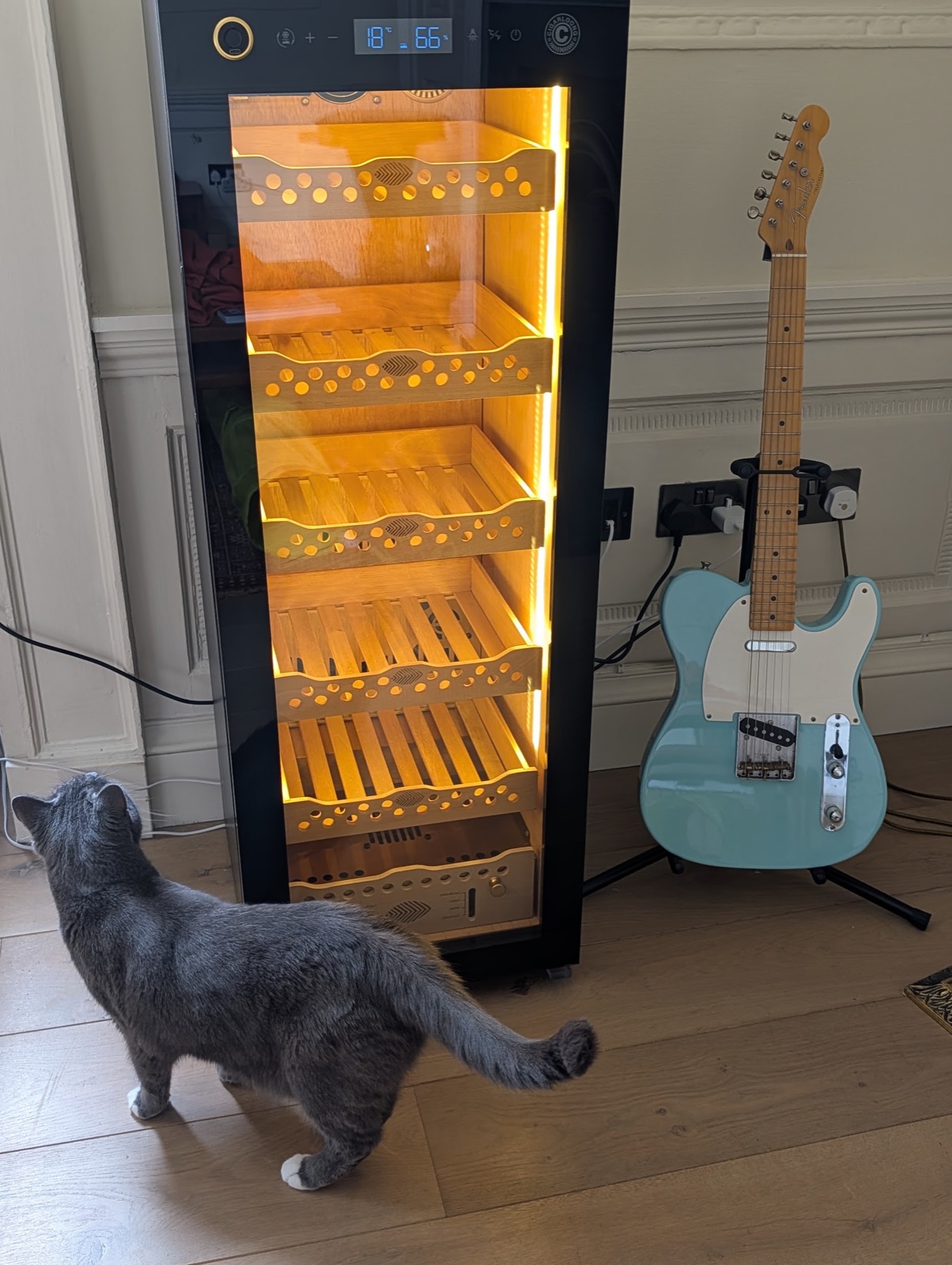
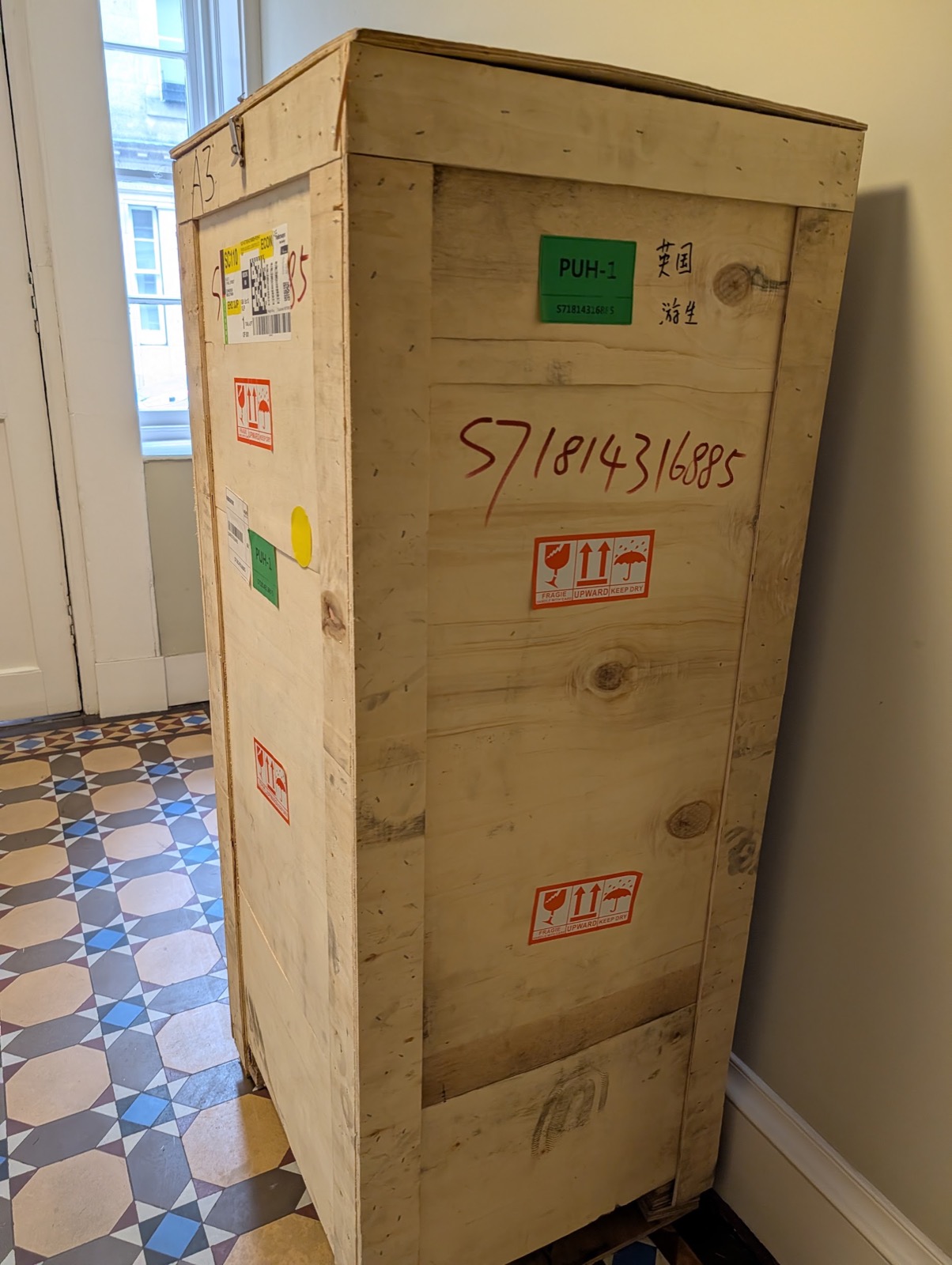
Delivery day: the post-delivery inspection under way (no faults found, but Chief Inspector Mr. Budgiepaws has yet to submit a written report), and the crate it came in.
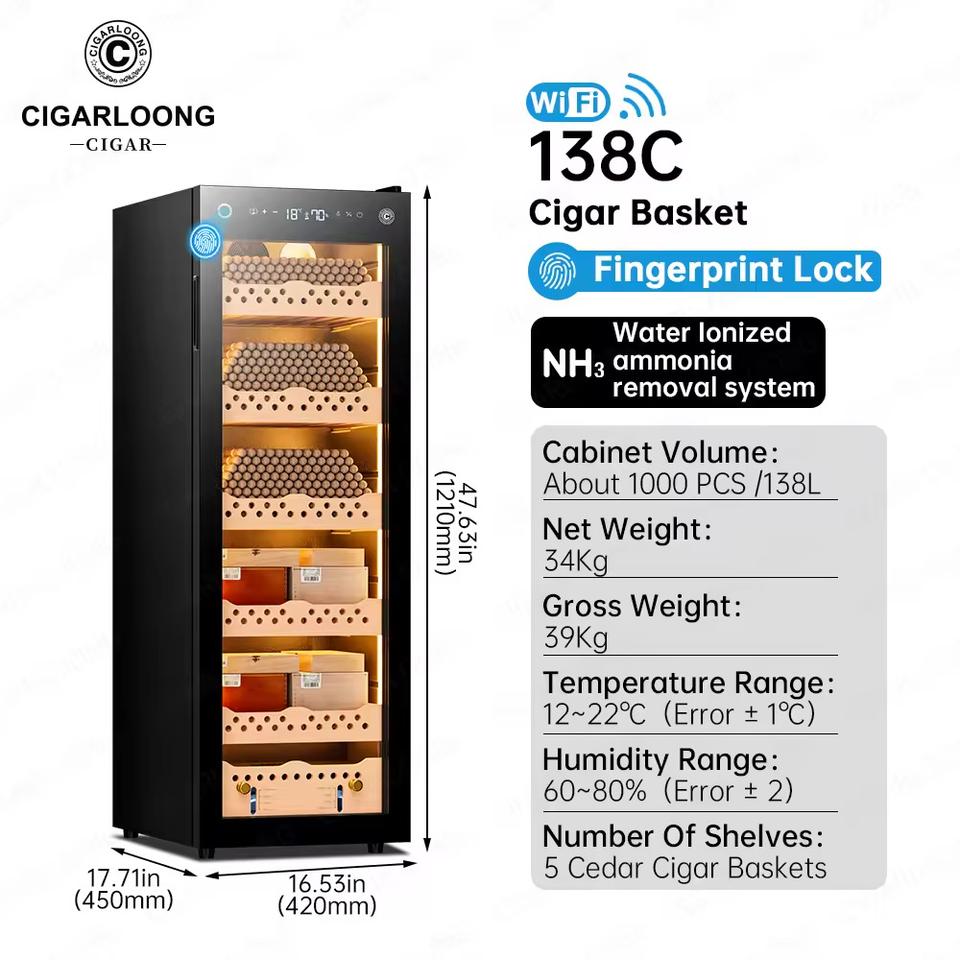
The maker's listing photo.
Specs
| Model | CIGARLOONG 138C, WiFi version |
|---|---|
| Capacity | About 1,000 cigars, 138 litres |
| Cooling and heating | Compressor cooling (not thermoelectric) and PTC heating. PTC stands for positive temperature coefficient: a self-regulating ceramic element whose resistance rises as it warms, so it is an ordinary resistive heater that cannot overheat. |
| Climate control | Temperature and humidity set independently, with internal circulation fans |
| Temperature range | 12 to 22 °C, ±1 °C |
| Humidity range | 60 to 80% RH, ±2 |
| Humidification | Reservoir in the base holding an absorbent block, distilled water; a fan blows across it (the same wick-and-fan idea as a room humidifier) |
| Sensors | One temperature and humidity sensor that I know of, just above the second shelf from the bottom. There may be others I have not spotted. |
| Shelving | Five cedar baskets |
| Features | Interior lighting, a water-ionised ammonia removal system, USB-C, a fingerprint lock and WiFi (haven't tried those yet) |
| Size | 420 mm wide, 450 mm deep, 1,250 mm tall |
| Weight | 34 kg net, 39 kg as shipped |
| Custom order | Full cedar lining inside and UK electrics with a UK plug, both requested in the order chat and done at the factory. Wherever you are, ask for your own plug and voltage explicitly. |
Delivery
It arrives in a wooden crate on roughly a quarter-pallet footprint, with a large Boveda humidity pack inside. The pack was still squishy on arrival.
In use
The ammonia removal system, which ionises the water vapour to neutralise what the cigars give off, is a genuinely nice feature. It runs itself for 30 minutes every 12 hours, and a button on the panel starts an extra 30-minute run whenever you like. The fingerprint sensor and the WiFi I have not found a way to use: there is presumably a compatible app somewhere, but the manual does not say which, and I have not gone looking hard. Maybe I'll vibe code one.
Why ammonia matters: tobacco leaf is full of nitrogen compounds, and fermentation breaks them down, giving off ammonia (NH3, one nitrogen atom with three hydrogens). That is the sharp smell of a fermentation room, and driving it out is much of what fermentation is for. It never quite finishes, so a rolled cigar keeps releasing ammonia for months, and a young one tastes harsh and chemical until it has rested. Cubans are sold younger than most, which is why they benefit from a rest and part of why people talk about the Cuban "twang". In a small desktop humidor the ammonia escapes every time the lid opens. In a sealed cabinet full of young stock it has nowhere to go, which is the case this system is for. It works by ionising the water vapour with a high-voltage needle, a corona discharge rather than a spark, which produces short-lived radicals that oxidise the ammonia into nitrogen gas (N2) and water (H2O). The same discharge makes a little ozone (O3), which is bad for cigars in quantity, so it runs in short bursts rather than continuously.
Do not run it cold
The one mistake I made: I ran it too cold for the room. It was set to 18 °C and 67%, which my small thermoelectric humidor holds without any trouble, but this was the warmest part of the year, so the compressor ran long and the base of the cabinet, the coldest part, got far colder than the display said. Air at 18 °C and 67% has a dew point of about 12 °C. Once the floor reached that, water condensed on it rather than on the cooling coil. The cedar trim down there became saturated and dripped, and mould started. The humidity display looked fine the whole time, because the sensor I know of is higher up.
Recovery meant taking every cigar out, airing the cabinet for days, wiping the affected wood with alcohol, then reseasoning and restocking. It now runs at 20 °C and 70% and there has been no condensation since. The lesson is that the gap between the room and the setpoint temperatures is what matters, not the setpoint itself. In a warm spell, raise the temperature a degree or two rather than let the compressor fight the room, but not past about 21 °C: tobacco beetle eggs, which ride along in plenty of cigars, hatch above that, and keeping cigars cool is what stops them. (The paper cites 18 to 21 °C and 65 to 70% as the storage range, with mould and an ammonia smell above 75%.) A home that runs hot all the time is a different problem, and that is where a cabinet that can hold a big gap without sweating earns its money.
They have smaller sizes
The model number is the capacity in litres, and some sizes come with a choice of baskets or drawers, with or without a cedar lining. Shipping for the other sizes is not known.
| 20C | about 50 cigars |
|---|---|
| 25C2 | about 80 cigars |
| 33C | about 150 cigars |
| 35C | about 200 cigars |
| 60C | about 200 cigars, baskets or drawers, with or without a cedar lining |
| 95C | baskets or drawers, with or without a cedar lining |
| 138C | about 1,000 cigars, the one I have |
Why are Rachings and the like so much more expensive?
A cabinet like the Raching MON2800 lists at roughly five times what mine cost delivered. Part of that is furniture: a wood frame, piano lacquer or burl panelling. Part is the channel: I bought factory-direct from a trading company, while a Raching passes through a brand, an importer, a dealer and a two-year warranty with six years on the compressor. Part is tariffs: that link is a US price, which carries US duty on Chinese goods, and Raching's European importer lists the same models about 10 to 20 percent lower, which narrows the gap without closing it (mine came straight from China to the UK, so no US tariff sits in its price; what your own country charges on a parcel from China is a separate question). But reading their material closely, there are also real engineering differences, and they aim at exactly the problem I had.
A caveat before the details: neither maker publishes an engineering description. What follows is an educated guess pieced together from marketing copy, dealer pages and one open-access research paper, plus what my own cabinet has shown me. The paper is Tan, Cao, Shi and Xu, "Experimental investigation on constant temperature and relative humidity control for cigar storage cabinet utilizing a water immersion evaporator", Energy Reports 16 (2026). It tests a Candor cabinet from Zhongshan, not a Raching; Raching's own material appears to describe the same design, but that is my inference. It is worth noting where the paper comes from: a university institute in Zhongshan working with two Guangdong appliance makers, the same industrial cluster these cabinets come out of, published open access in 2026. Treat what follows as a plausible account, not a teardown.
Sensors. Raching's current MON cabinets claim up to seven temperature and humidity sensors spread from the top of the cabinet to the bottom. The paper shows why that is not decoration: measuring seven shelves of one cabinet, the authors found up to 4.5 °C and 12 to 14 humidity points between shelves before they tuned the airflow, and within 0.7 °C after. Mine has one that I know of, just above the second shelf from the bottom; there may be others, but if so they did not stop the floor getting wet while the display read fine.
How the cold gets in. Mine is a normal frost-free fridge arrangement: a refrigerant coil hidden behind a panel, likely in the base, far below freezing whenever the compressor is on, with fans doing the rest: one at the top pushes the chilled air into the cabinet, two circulate it, and one at the bottom blows across the water reservoir. There is no coil visible inside. The coil is either very cold or off, nothing in between, so in a warm room it runs long. Cold air sinks, and the humidifier sits at the bottom, so the floor is where the coldest air meets the wettest air. A PTC heater covers the other direction. The paper puts the problem plainly: in an air-cooled cabinet the coil runs below the dew point, so cabinet moisture condenses on it whenever the compressor runs, and the authors call the resulting swings "unavoidable in such systems". Their design, which Raching's newer cabinets appear to share, sinks the refrigerant coil in a tank of water instead, and a pump circulates that chilled water through a radiator inside the cabinet. The water leaves the radiator within half a degree of how it arrived, so the radiator is only slightly cooler than the air, and the tank's thermal mass means the compressor cycles far less often. Nothing inside gets cold enough to sweat by accident.
Dehumidifying on purpose. With that water loop, dehumidifying is a deliberate act: the controller lowers the tank water below the dew point, water condenses on the radiator, and a drain carries it away. Humidifying uses the same water: a spray pipe wets the radiator and the fan speed sets how much evaporates. The heater cuts in when the cabinet falls two degrees below the setpoint. One loop does cooling, drying and humidifying, under a control algorithm that Raching, like CIGARLOONG, calls PID (proportional, integral, derivative: the standard way of steering toward a setpoint smoothly instead of switching on and off around it, as in a thermostat or cruise control). Mine claims dehumidification too, but its listing does not say how, and with a plain coil the only route is running the compressor and the heater together. A frost-free coil drains its own meltwater to a tray on the compressor; water that condenses on the cabinet floor instead has nowhere to go.
What is the same. Both humidify by evaporating distilled water off a wet surface with a fan. Both heat with a PTC element. Both have an ammonia removal system, Raching quoting a percentage and mine running a timed cycle. Both hold the same range of temperature and humidity on paper.
So the extra money buys three things beyond looks: sensors where the trouble happens, a cooling design that cannot make a cold spot by accident, and someone to call. The simplest reading may be that a Raching is the same idea engineered more carefully all the way through, with more sensors, better-chosen parts and a gentler cooling loop even where the two overlap on paper, and that this, together with the support network and the reputation, is what the price is for. Whether it is worth this much more depends on the person. My cabinet does the job, and it taught me the one rule I needed for the price of an afternoon's cleaning: keep the setpoint close to the room.